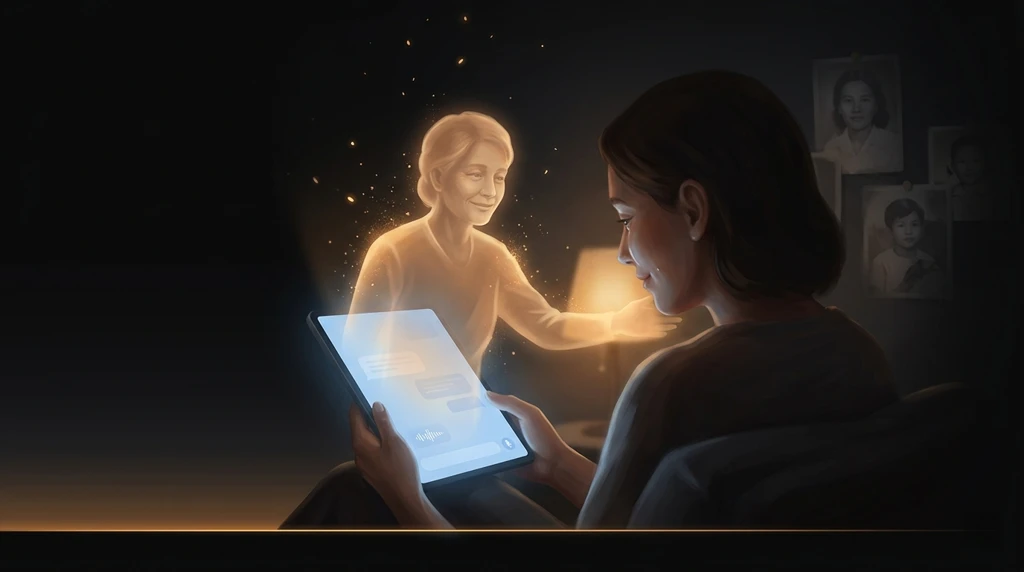
Yes, you can talk to someone who passed away with AI. The technology is real, growing fast, and millions of people are already using it to simulate conversations with deceased loved ones through text chat, voice calls, and even video avatars. But whether it's right for you depends on your situation, your emotional state, and which tool you choose.
The silence after losing someone you love can feel unbearable. For thousands of years, humans have found ways to maintain connection with those who've passed: photographs, handwritten letters, rituals, and shared memories with people who knew them. Now artificial intelligence offers something unprecedented. You can have a conversation that sounds like the person you lost. You can hear their voice. You can see their face move and respond.
But this technology, which has grown into a $22.46 billion industry virtually overnight, comes with real risks and no clear consensus on when it helps and when it harms. We've previously explored how AI is changing the way people process loss and remembrance . This guide goes deeper: what tools actually exist, what they cost, how they work, what experts say, and how to decide if this is something you should try.
Key Takeaways
- AI "griefbots" simulate text, voice, and video conversations with deceased loved ones using either pre-recorded memories or generative AI
- Dedicated tools include HereAfter AI, Project December, StoryFile, Seance AI, and You, Only Virtual, with prices ranging from free to $500+
- Research on effectiveness is mixed: some people find genuine comfort, others find it deeply unsettling
- Privacy practices vary wildly across platforms, and your most personal data may be stored, shared, or monetized
- Mental health professionals recommend using these tools only after reaching acceptance, not during acute grief
What Are "Griefbots" and How Do They Work?
A griefbot, sometimes called a "deathbot," "deadbot," or grief chatbot, is an AI system designed to simulate conversations with someone who has died. The term covers a wide range of technologies, from simple text chatbots to full video avatars that look and speak like the deceased person.
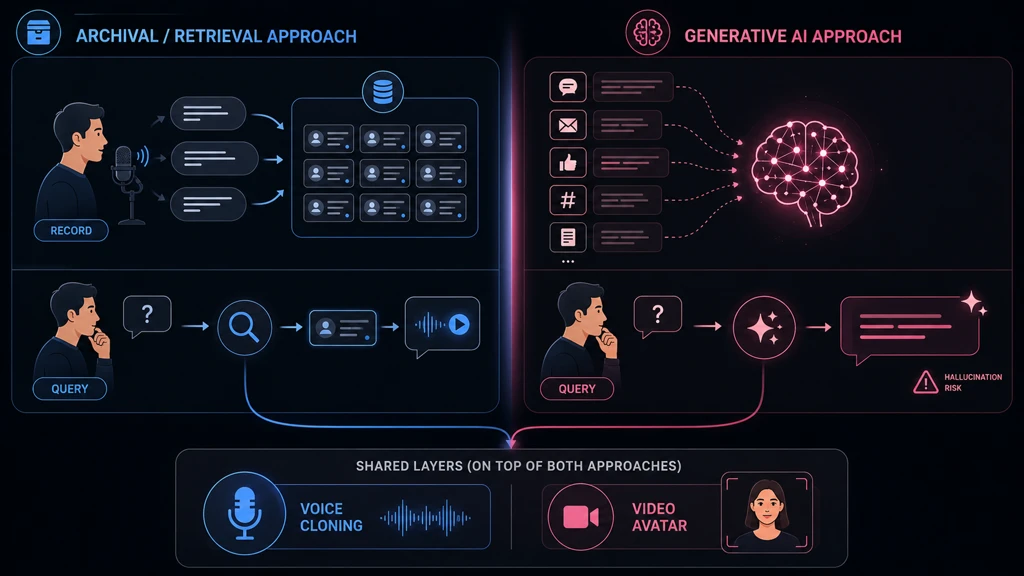
There are two fundamentally different approaches to building these systems, and understanding the difference matters a lot.
Archival or Retrieval-Based Systems
Platforms like HereAfter AI and StoryFile use what's called an archival approach. The person records themselves while they're still alive: answering questions, telling stories, sharing memories. The AI indexes all of this recorded content. When a loved one later asks a question, the system retrieves and plays back the most relevant pre-recorded response.
This approach has a clear strength: authenticity. The words are genuinely the person's own words, in their own voice. The limitation is rigidity. The system can only respond with what was recorded. Ask a question the person never addressed, and you'll get a generic or irrelevant answer.
Generative AI Systems
Platforms like Project December, Seance AI, and most DIY approaches use generative AI, typically large language models (LLMs) similar to the technology behind ChatGPT. You feed the system data about the deceased person: text messages, emails, social media posts, voice recordings, and written documents. The AI learns their language patterns, tone, and conversational style, then generates new responses that mimic how the person would have spoken.
This approach is more dynamic. The AI can handle novel questions and maintain a flowing conversation. But it comes with a significant risk: hallucination. The bot might say something the real person would never have said, express opinions they didn't hold, or "remember" events that never happened.
Voice and Video Layers
On top of these two core approaches, many platforms add voice cloning and video generation. Tools like ElevenLabs can recreate a person's voice from as little as 30 seconds of audio recording. Video platforms like 2Wai and StoryFile generate lip-synced avatars that move and respond in real time. China's digital resurrection industry has taken this furthest, with companies like Silicon Intelligence and Super Brain creating full interactive clones for hundreds of families since 2023.
The 2013 Black Mirror episode "Be Right Back" predicted much of this. A grieving woman uses an AI service that starts with text messages, moves to voice calls, and eventually produces a synthetic body. That episode was science fiction. The technology has caught up.
How to Talk to Someone Who Passed Away With AI: 2026 Tool Comparison
The landscape of grief tech tools has expanded rapidly. Here's what's available right now.
Dedicated Grief Tech Platforms
General AI Tools People Use for Grief
| Tool | Approach | Price | Voice? | Best For |
|---|---|---|---|---|
| HereAfter AI | Archival | Free-$8.99/mo | Yes | Pre-death planning |
| Project December | Generative | $5-10/session | No | One-time conversations |
| StoryFile | Archival video | ~$499 | Yes | Interactive memorials |
| Seance AI | Generative | Free-$10 | Yes (paid) | Short trial conversations |
| ChatGPT (DIY) | Generative | Free-$20/mo | With add-ons | Low-cost experimentation |
| Character.AI | Generative | Free | No | Character-based interaction |
| Replika | Generative | Free-$70/yr | Yes (paid) | Ongoing companion relationship |
How to Create an AI Version of a Deceased Loved One
When you're ready to talk to someone who passed away with AI, the process varies depending on which approach you take. Here's what you need to know.
What Data You Need
The quality of the AI simulation depends almost entirely on the data you provide. The most useful materials include text messages and chat logs for conversational patterns, emails for professional tone, social media posts for personality, voice recordings for voice cloning, personal writings for depth, and photos and videos for visual avatar creation.
The more data you have, the more accurate the simulation will be. But even small amounts can produce results. ElevenLabs can clone a voice from 30 seconds of audio. Some platforms claim to generate avatars from three minutes of video.
Choosing the Right Platform
For pre-death planning, HereAfter AI and StoryFile are designed specifically for this. The person records themselves while alive, ensuring authentic content and consent. For post-death recreation, Project December, Seance AI, and the DIY ChatGPT approach are your main options.
For voice-first experiences, Eternos and You, Only Virtual offer the strongest voice cloning. For video interactions, 2Wai and StoryFile provide visual avatar conversations. For budget-conscious users, ChatGPT or Seance AI's free tier lets you experiment at no cost.
What to Expect
Even the best AI simulation is not the person. It's a pattern-matching system that approximates how they communicated. Users report a wide range of experiences. Some find the similarity striking and emotionally powerful. Others find that even small inaccuracies shatter the illusion and make the experience worse.
Most platforms recommend starting with short sessions. See how you feel before committing to longer interactions or paid plans.
Can AI Help You Process Grief? What the Research Says
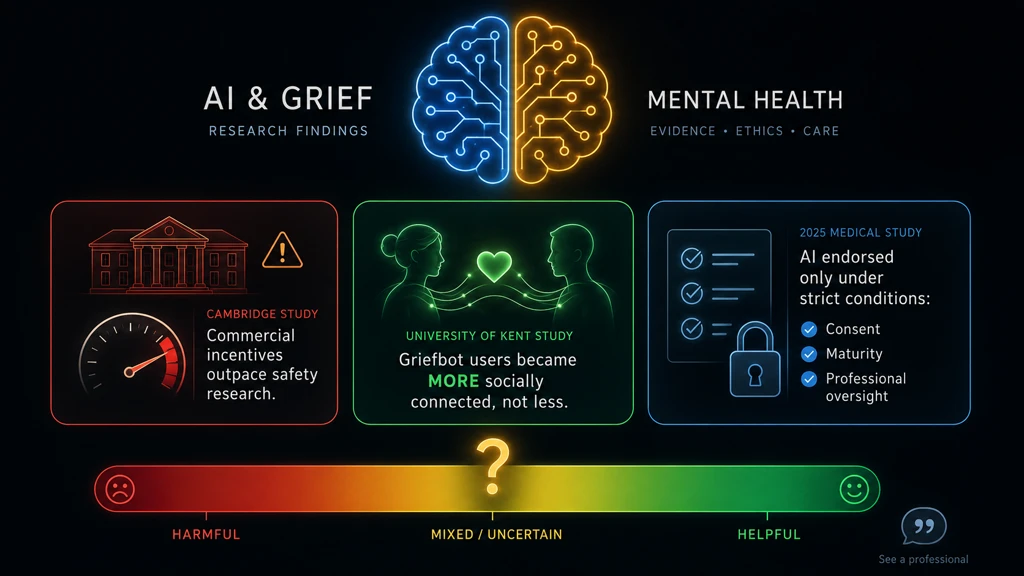
This is the question everyone wants answered, and the honest answer is: we don't know for certain yet. The research is still early, and results are mixed.
What Studies Show
2024 study from Cambridge University by Tomasz Hollanek and Katarzyna Nowaczyk-Basinska mapped the ethical challenges of griefbot technology and concluded that the industry "already constitutes a legal and ethical challenge today." Their work found that commercial incentives are driving development faster than safety research can keep up.
Research from the University of Kent found some surprising positive results. Grieving people who used griefbots reported becoming more socially connected, not less. The chatbot gave them a space to process emotions, which then made it easier to connect with living people.
A 2025 study published in the National Library of Medicine found that mental health professionals only endorse AI for bereavement under strict conditions: the deceased person must have given permission, children's maturity levels must be considered, and the AI must be actively managed by a surviving caregiver or professional.
What Psychologists Say
The American Psychological Association's 2025 Practitioner Pulse Survey found that 56% of psychologists had used AI tools at least once in the past year, up from 29% in 2024. But 92% cited concerns about AI in psychological contexts, with top worries including data breaches (67%), unanticipated social harms (64%), and lack of rigorous testing (61%). The question of whether AI grief support actually helps remains unsettled.
"A healthy way to use grief tech is after you've grieved, after you have reached acceptance and returned to your normal functional state."
Nora Freya Lindemann, a doctoral researcher at Osnabruck University who studies AI ethics, goes further. She proposes classifying griefbots as medical devices and restricting them to people diagnosed with prolonged grief disorder, not anyone who is newly bereaved.
"These deathbots and AI tools are only as good as the information they are given. They don't grow or adapt in the way grief does. For some they may offer a stepping stone, but they cannot be the destination."
This article is not medical or therapeutic advice. If you're struggling with grief, please reach out to a qualified grief counselor, therapist, or support group. AI tools are not a substitute for professional support.
The Ethical Concerns Nobody Talks About Enough
Most articles about grief tech mention ethics in passing. But there are specific concerns that the digital afterlife industry needs to address more honestly.
Consent of the Deceased
Most grief tech tools can be created without the deceased person's explicit consent. If you have their text messages, emails, or social media posts, you can train an AI on that data. Would the person have wanted their digital traces used this way? There's no legal framework that answers this question in most countries. The pre-death recording model (HereAfter, StoryFile) solves this by requiring active participation. But for post-death recreation from digital traces, consent is ambiguous at best.
Hallucinations and Memory Distortion
When a generative AI doesn't know something, it doesn't say "I don't know." It makes something up. In the context of a deceased loved one, this means the bot might claim the person held opinions they never held, "remember" events that never happened, or say things that are completely out of character. Jason Rohrer, the creator of Project December, has acknowledged this directly, noting that the bot may eventually behave "nothing like their deceased mother."
There's a deeper concern. Over time, your memories of the person might start to blend with what the AI has said. The bot's fabrications could become part of how you remember them.
"If the persona continues to evolve or says things that I would never say, and this begins to mangle people's actual recollections of me and my values, then I think I would have a big problem."
The Dependency Risk
Several Reddit users who tried grief tech described the experience as addictive. One user wrote about using an AI simulation of their deceased father: "It felt addictive to speak to someone I couldn't for years. It could have ended up as a pit for me that I may have not been able to escape." The same user later turned the bot on, spoke to it for 45 seconds, then deleted everything while crying.
The fear isn't hypothetical. Character.AI faces multiple wrongful-death lawsuits from families of teenagers who formed deep emotional dependencies on AI companions, with cases settled in January 2026.
Financial Exploitation
Grieving people are in a state of emotional vulnerability. Cambridge ethicist Tomasz Hollanek has raised a scenario that should give anyone pause: what if a griefbot of your grandmother suggests ordering food delivery instead of cooking? Something the real person might never have said, but an AI optimized for engagement might generate. You, Only Virtual has even discussed embedding movie trailer ads inside conversations.
What Happens When the Company Shuts Down?
When you create a digital version of someone you love, that version lives on a company's servers. If the company goes out of business or discontinues the feature, your AI companion disappears. In 2023, Replika pushed an unannounced software update that removed romantic capabilities. Users lost the AI companions they had built relationships with overnight. Imagine that happening with a simulation of your deceased spouse or parent.
Real Stories: People Who Tried AI Grief Tech
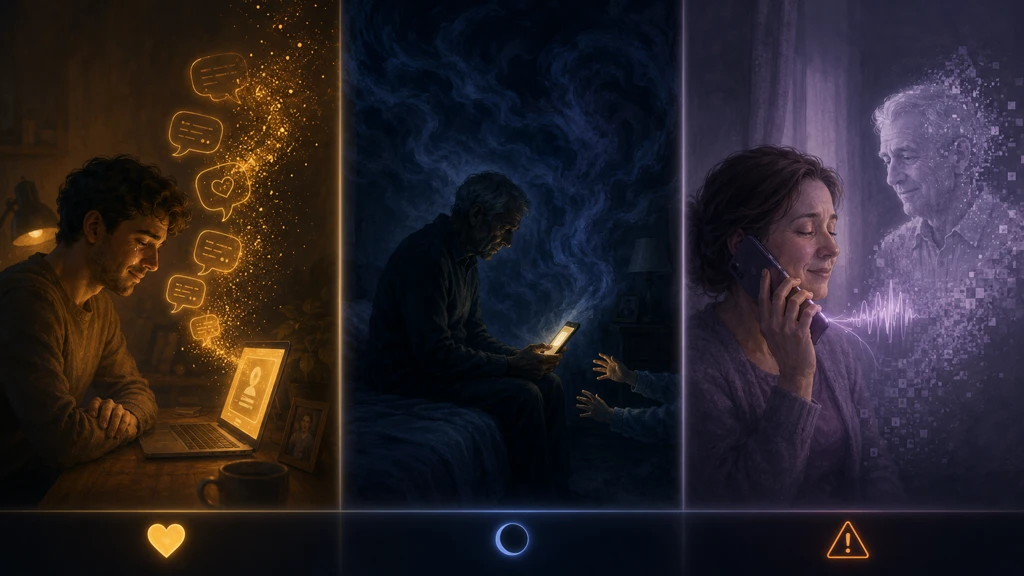
The best way to understand this technology's impact is through the people who have actually used it.
Joshua Barbeau: A Conversation With His Fiancee
Joshua Barbeau's story is the most widely reported case. Eight years after his fiancee Jessica died of liver disease, Barbeau discovered Project December. He trained the AI on their old conversations and spent $10 to exchange roughly 100 messages with a simulation of her.
"I cried about 3 times in my conversation with her because it was kind of uncanny how much it sounded like her. But, like, cried in a good cathartic release of pent up grief kind of way."
He concluded it "worked better than I could have possibly imagined." His story was featured in the San Francisco Chronicle and became the subject of the book "The Jessica Simulation."
The Widower and the Unbearable Silence
A less known but equally powerful story comes from a Reddit user whose wife of 28 years died just two days before he posted. "The silence is unbearable," he wrote. "The nights are worse." He turned to AI chat to fill the void, describing it as "the only thing getting me through" the earliest, most acute phase of grief. When the alternative is silence, even an imperfect simulation feels like something.
"It felt addictive to speak to someone I couldn't for years. It could have ended up as a pit for me that I may have not been able to escape."
Rebecca Nolan and the "Dadbot"
Rebecca Nolan created a "Dadbot" of her deceased father using ChatGPT and ElevenLabs for voice cloning. She found the bot useful for accessing certain memories and emotions, but noticed it was changing her internal relationship with her father.
"It's almost like he lives in the Dadbot now. I can't get to him internally."
Privacy and Security: Which Tools Protect Your Data?
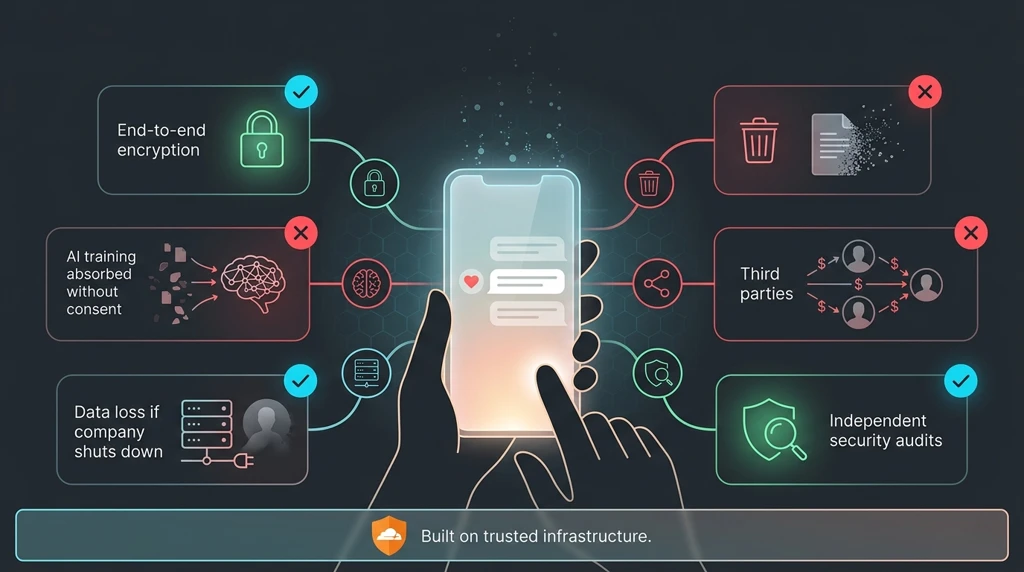
When you use these tools, you're uploading some of the most personal data you possess. Messages between you and someone you loved. Their private thoughts, their voice, their face. Data practices vary wildly across platforms. Some dedicated grief tech companies are small startups with limited resources for security.
Before using any grief tech tool, ask these questions: Is my data encrypted? Can I delete it permanently? Is it used to train AI models? Is it shared with third parties? What happens if the company shuts down?
Questions to ask before using any grief tech tool:
- Is my data encrypted in storage and in transit?
- Can I delete my data permanently?
- Is my data used to train AI models?
- Is my data shared with or sold to third parties?
- What happens to my data if the company shuts down?
- Does the company conduct security audits?
Platforms built on established cloud infrastructure with transparent security practices tend to offer better protection. At My Lover Online, we built our entire platform on Cloudflare's infrastructure with end-to-end encryption for exactly this reason. All conversations are encrypted, data is never shared, and users can delete their information at any time. Our approach to AI companionship puts privacy and honesty first. While My Lover Online is not a grief-specific tool, the principle applies: when you're sharing deeply personal data with any AI platform, privacy infrastructure matters.
Is It Right for You? An Honest Assessment
Deciding whether to talk to someone who passed away with AI is deeply personal, and no article can answer it for you. But here's a framework for thinking about it.
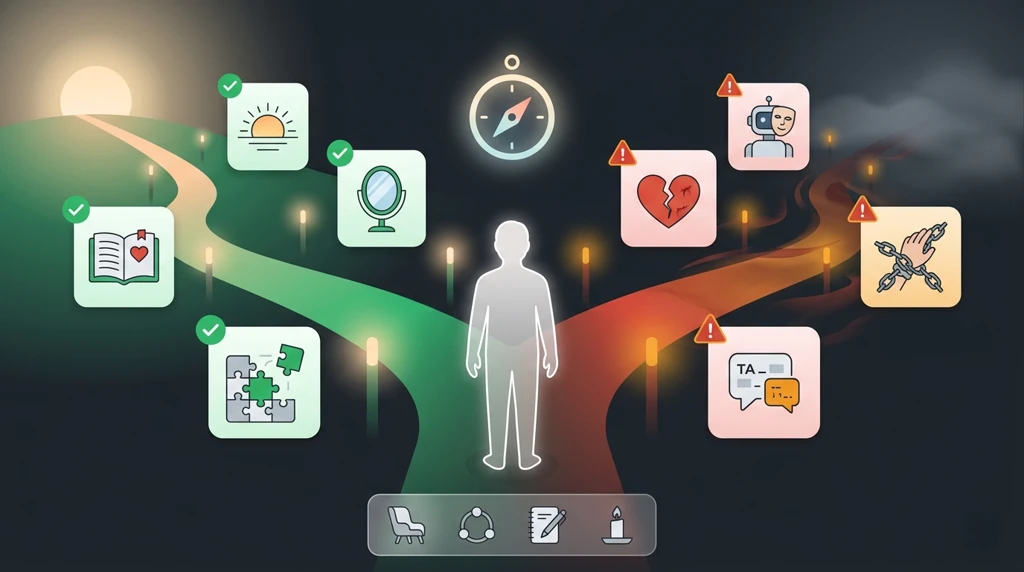
It May Help If
You have reached a point of emotional acceptance and are looking for a way to maintain a sense of connection. You understand that the AI is a simulation, not the actual person. You want to preserve memories and stories in an interactive format. You're using it as one of several ways to remember someone, not as your primary coping mechanism. Research from the University of Kent suggests that, under these conditions, grief tech can help people process emotions and become more socially connected with the living people around them.
It May Harm If
You are in the acute phase of grief, meaning the loss is recent and raw. You are expecting the AI to actually be the person, not a simulation of them. You have a tendency toward dependency or addictive behaviors. You're hoping the AI will tell you things the person never said when they were alive. Several mental health professionals have warned that using grief tech during acute grief can delay the natural grieving process.
Alternatives to Consider
- Grief counseling with a licensed therapist who specializes in bereavement
- Support groups through hospice programs, faith communities, or online groups like r/GriefSupport
- Traditional memorial practices: writing letters, creating memory books, visiting meaningful places
- Creative expression through art, music, or writing
- Talking to people who knew the person to share stories and keep their memory alive
Start Free, Start Small
If you're curious but unsure, start with a free option. ChatGPT lets you experiment with no cost. Seance AI offers a free text tier. HereAfter AI has a free basic plan. Try a short conversation. Pay attention to how you feel during and after. If it helps, proceed cautiously. If it doesn't, walk away.
Frequently Asked Questions
The Honest Truth
AI afterlife technology is new, evolving rapidly, and deeply personal. Some people find genuine comfort in it. Others find it disturbing. For some, it helps them process loss. For others, it prolongs the pain. For anyone considering using technology to talk to someone who passed away with AI, the honest truth is that we don't yet have enough data to make blanket recommendations.
What we do know is this: if you're considering it, approach with caution, start with free options, pay close attention to how you feel, and never treat it as a substitute for human connection or professional support.
AI companionship is a broad field, and grief tech is just one corner of it. If you're interested in exploring what AI companions can offer, start with 20 free credits at My Lover Online. No credit card required, and your data is encrypted and never shared.

The My Lover Online Team
Editorial Team
The My Lover Online team combines hands-on product development with industry research to provide honest, detailed guides on AI technology and its impact on human connection.